← Back
📁 MARK'S DOC
🔗 Linked Evidence
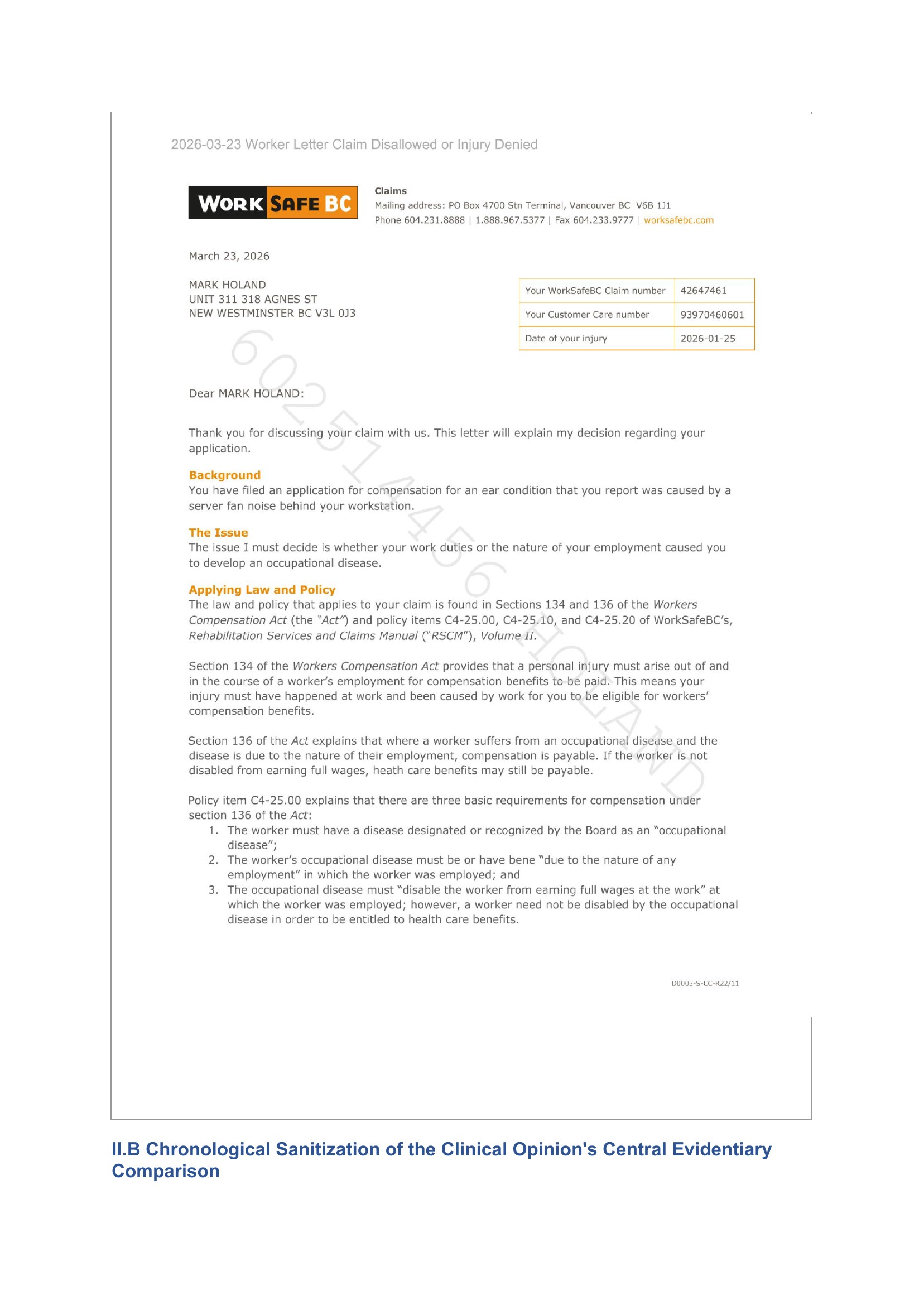
Review_Division_Submission_1_of_3 — p.4
📄 Review Division Submission 1 of 3 | p.4
📄 Review Division Submission 1 of 3 | p.4
📝 Extracted Text (OCR)
2026-03-23 Worker Letter Claim Disallowed or Injury Denied

Claims
BC Mailing address: PO Box 4700 Stn Terminal, Vancouver BC V6B 131
Phone 604.231.8888 | 1.888.967.5377 | Fax 604.233.9777 | worksafebc.com

Wo

March 23, 2026

MARK HOLAND Your WorkSafeBC Claim number | 42647461
UNIT 311 318 AGNES ST
NEW WESTMINSTER BC V3L 033 Your Customer Care number —_| 93970460601

Date of your injury 2026-01-25

Dear MARK HOLAND:

Thank you for discussing your claim with us. This letter will explain my decision regarding your
application.

Background
You have filed an application for compensation for an ear condition that you report was caused by a
server fan noise behind your workstation.

The Issue
The issue I must decide is whether your work duties or the nature of your employment caused you
to develop an occupational disease.

Applying Law and Policy

The law and policy that applies to your claim is found in Sections 134 and 136 of the Workers
Compensation Act (the "Act”) and policy items C4-25.00, C4-25.10, and C4-25.20 of WorkSafeBC’'s,
Rehabilitation Services and Claims Manual (“RSCM"), Volume II.

Section 134 of the Workers Compensation Act provides that a personal injury must arise out of and
in the course of a worker's employment for compensation benefits to be paid. This means your
injury must have happened at work and been caused by work for you to be eligible for workers’
compensation benefits.

Section 136 of the Act explains that where a worker suffers from an occupational disease and the
disease is due to the nature of their employment, compensation is payable. If the worker is not
disabled from earning full wages, heath care benefits may still be payable.

Policy item C4-25.00 explains that there are three basic requirements for compensation under
section 136 of the Act:
1. The worker must have a disease designated or recognized by the Board as an “occupational
disease”;
2. The worker's occupational disease must be or have bene “due to the nature of any
employment” in which the worker was employed; and
3. The occupational disease must “disable the worker from earning full wages at the work” at
which the worker was employed; however, a worker need not be disabled by the occupational
disease in order to be entitled to health care benefits.

D0003-S-CC-R22/11

II.B Chronological Sanitization of the Cli
Comparison

ion's Central Evidentiary