← Back
📁 MARK'S DOC
🔗 Linked Evidence
The_Pang_Formula_and_the_BEAST — p.7
📄 The Pang Formula and the BEAST | p.7
📄 The Pang Formula and the BEAST | p.7
📝 Extracted Text (OCR)
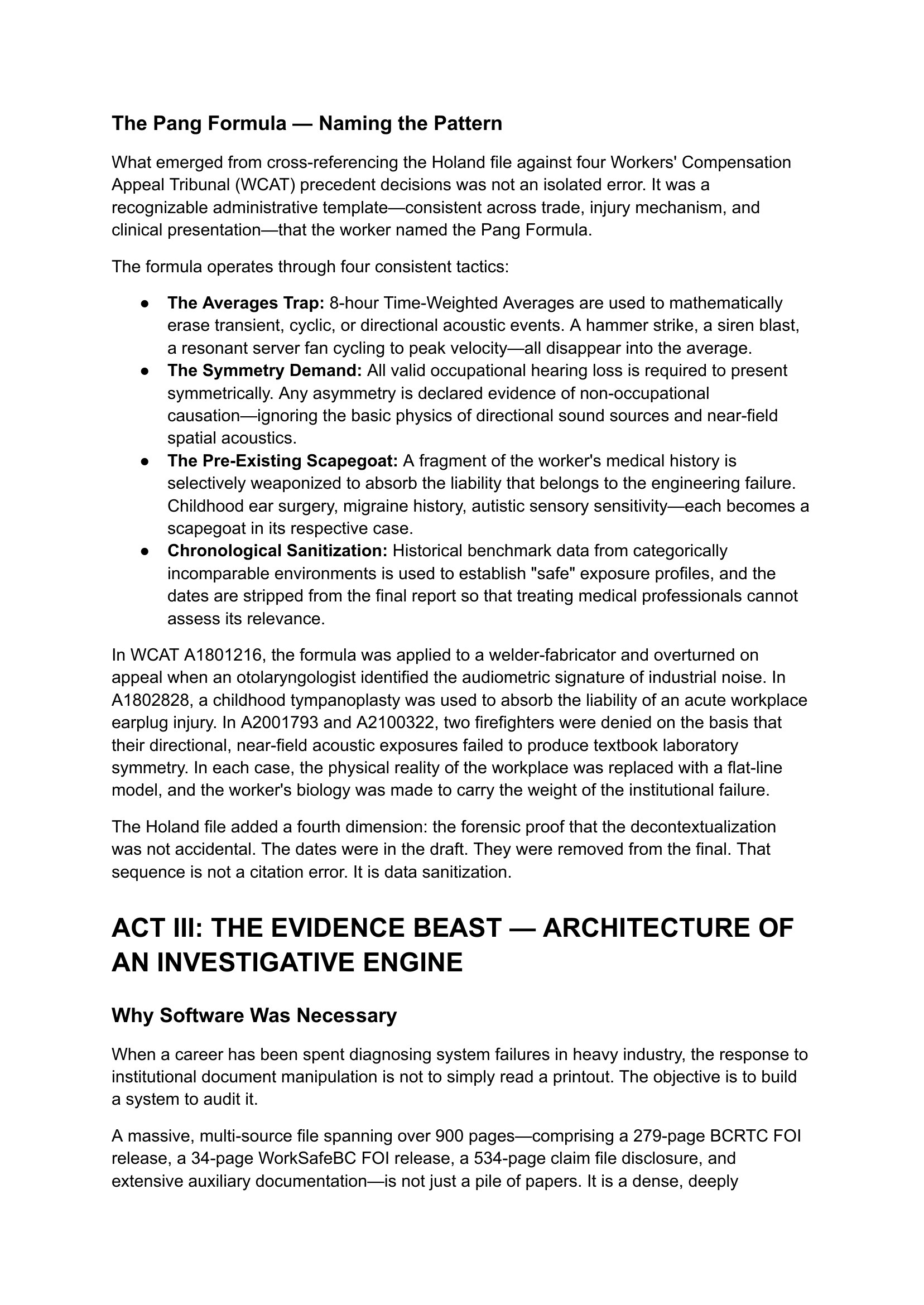
The Pang Formula — Naming the Pattern

What emerged from cross-referencing the Holand file against four Workers' Compensation
Appeal Tribunal (WCAT) precedent decisions was not an isolated error. It was a
recognizable administrative template—consistent across trade, injury mechanism, and
clinical presentation—that the worker named the Pang Formula.

The formula operates through four consistent tactics:

e The Averages Trap: 8-hour Time-Weighted Averages are used to mathematically
erase transient, cyclic, or directional acoustic events. A hammer strike, a siren blast,
a resonant server fan cycling to peak velocity—all disappear into the average.

e The Symmetry Demand: All valid occupational hearing loss is required to present
symmetrically. Any asymmetry is declared evidence of non-occupational
causation—ignoring the basic physics of directional sound sources and near-field
spatial acoustics.

e The Pre-Existing Scapegoat: A fragment of the worker's medical history is
selectively weaponized to absorb the liability that belongs to the engineering failure.
Childhood ear surgery, migraine history, autistic sensory sensitivity—each becomes a
scapegoat in its respective case.

e Chronological Sanitization: Historical benchmark data from categorically
incomparable environments is used to establish "safe" exposure profiles, and the
dates are stripped from the final report so that treating medical professionals cannot
assess its relevance.

In WCAT A1801216, the formula was applied to a welder-fabricator and overturned on
appeal when an otolaryngologist identified the audiometric signature of industrial noise. In
A1802828, a childhood tympanoplasty was used to absorb the liability of an acute workplace
earplug injury. In A2001793 and A2100322, two firefighters were denied on the basis that
their directional, near-field acoustic exposures failed to produce textbook laboratory
symmetry. In each case, the physical reality of the workplace was replaced with a flat-line
model, and the worker's biology was made to carry the weight of the institutional failure.

The Holand file added a fourth dimension: the forensic proof that the decontextualization
was not accidental. The dates were in the draft. They were removed from the final. That
sequence is not a citation error. It is data sanitization.

ACT Ill: THE EVIDENCE BEAST — ARCHITECTURE OF
AN INVESTIGATIVE ENGINE

Why Software Was Necessary

When a career has been spent diagnosing system failures in heavy industry, the response to
institutional document manipulation is not to simply read a printout. The objective is to build
a system to audit it.

A massive, multi-source file spanning over 900 pages—comprising a 279-page BCRTC FOI
release, a 34-page WorkSafeBC FOI release, a 534-page claim file disclosure, and
extensive auxiliary documentation—is not just a pile of papers. It is a dense, deeply