🔗 Linked Evidence
The_Pang_Formula — p.8
📄 The Pang Formula | p.8
📄 The Pang Formula | p.8
📝 Extracted Text (OCR)
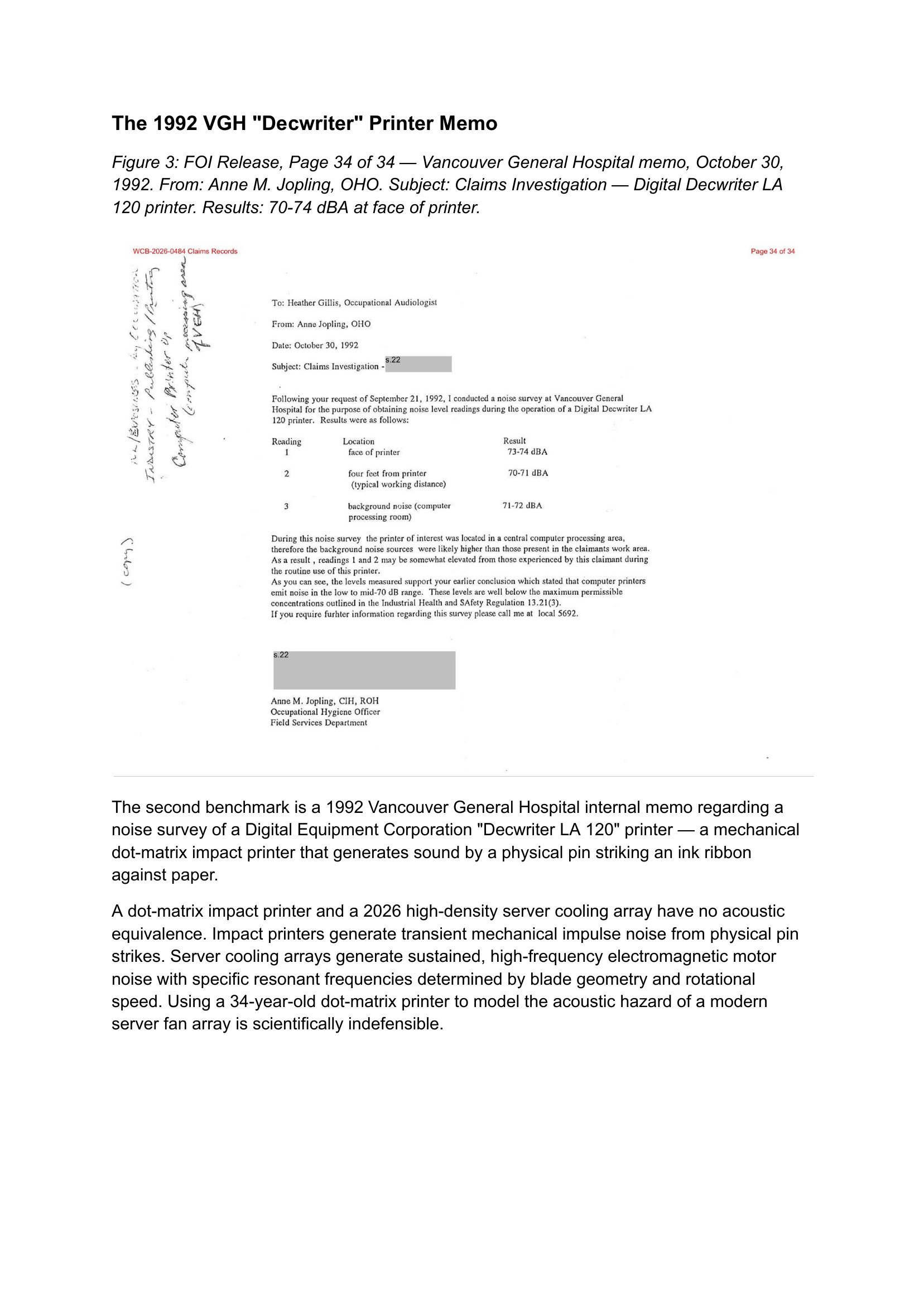
The 1992 VGH "Decwriter" Printer Memo

Figure 3: FOI Release, Page 34 of 34 — Vancouver General Hospital memo, October 30,
1992. From: Anne M. Jopling, OHO. Subject: Claims Investigation — Digital Decwriter LA
120 printer. Results: 70-74 dBA at face of printer.

WCB-2026-0484 Claims Records Page 34 of 34

aoe |
|
= $
a * To: Heather Gillis, Occupational Audiologist
at
e S ‘ wT From: Anne Jopling, OHO
Sys 'S
as y Date: October 30, 1992
PR n_ =
ae 8:
yt Subject: Claims Investigation -
e&>
2 Following your request of September 21, 1992, I conducted a noise survey at Vancouver General
i Se Hospital for the purpose of obtaining noise level readings during the operation of a Digital Deewriter LA
gy 120 printer, Results were as follows:
ary &
~ . Reading Location Result
ig oo 1 face of printer 73-74 dBA
8 2 four feet from printer 70-71 dBA
(typical working distance)
3 background noise (computer 71-72. dBA
processing room)
aA During this noise survey the printer of interest was located in a central computer processing area,
c therefore the background noise sources were likely higher than those present in the claimants work area.
a Asa result , readings 1 and 2 may be somewhat elevated from those experienced by this claimant during

the routine use of this printer.
As you can see, the levels measured support your earlier conclusion which stated that computer printers
emit noise in the low to mid-70 dB range. These levels are well below the maximum permissible
concentrations outlined in the Industrial Health and SAfety Regulation 13.21(3).

If you require furhter information regarding this survey please call me at local 5692.

(¢

Anne M. Jopling, CIH, ROH
Occupational Hygiene Officer
Field Services Department

The second benchmark is a 1992 Vancouver General Hospital internal memo regarding a
noise survey of a Digital Equipment Corporation "Decwriter LA 120" printer — a mechanical
dot-matrix impact printer that generates sound by a physical pin striking an ink ribbon
against paper.

A dot-matrix impact printer and a 2026 high-density server cooling array have no acoustic
equivalence. Impact printers generate transient mechanical impulse noise from physical pin
strikes. Server cooling arrays generate sustained, high-frequency electromagnetic motor
noise with specific resonant frequencies determined by blade geometry and rotational
speed. Using a 34-year-old dot-matrix printer to model the acoustic hazard of a modern
server fan array is scientifically indefensible.