← Back
📁 MARK'S DOC
🔗 Linked Evidence
Audiologist Advisor F.P. Records 09
📄 Worksafe FOI | p.1
📄 Worksafe FOI | p.1
📝 Extracted Text (OCR)
WCB-2026-0484 Claims Records Page 27 of 34

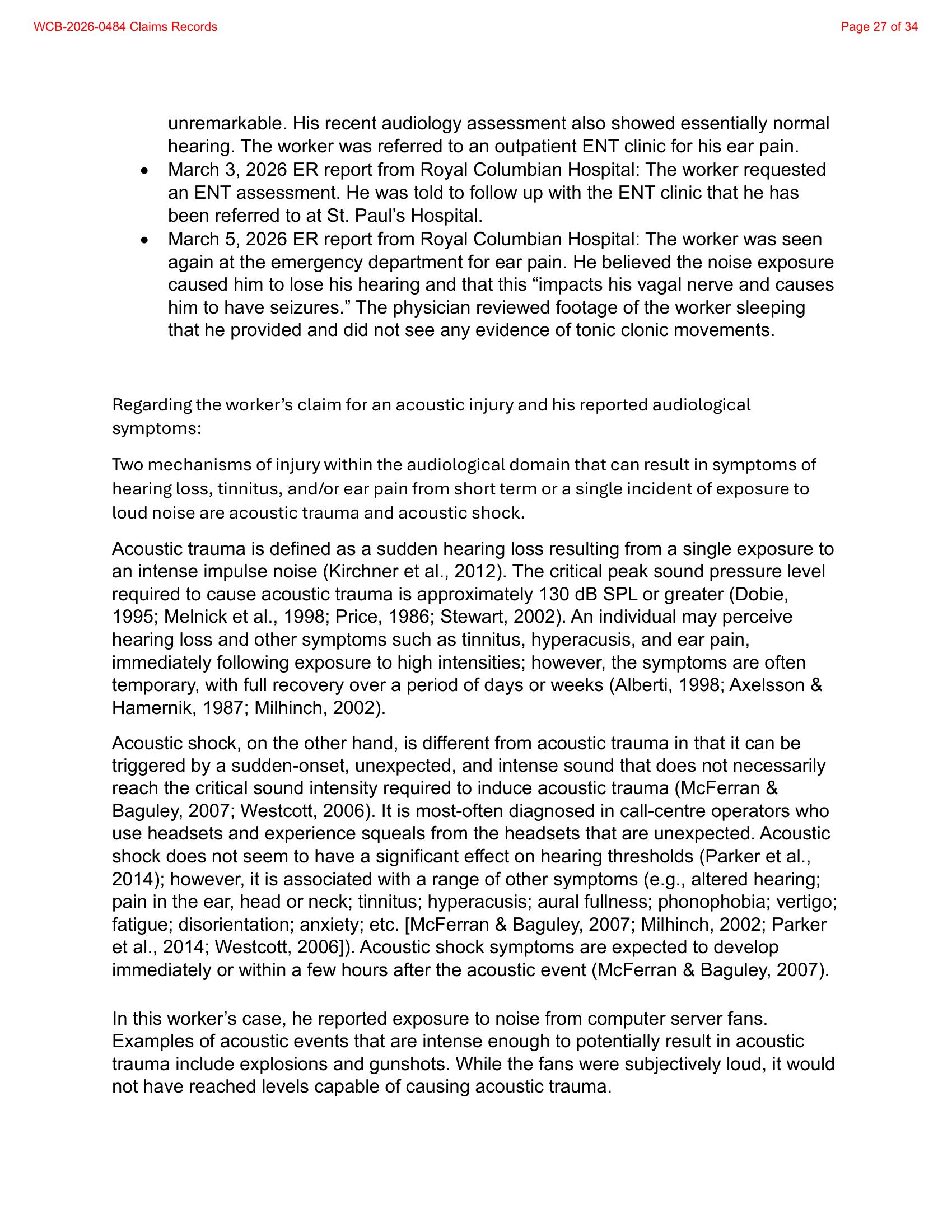
unremarkable. His recent audiology assessment also showed essentially normal
hearing. The worker was referred to an outpatient ENT clinic for his ear pain.

e March 3, 2026 ER report from Royal Columbian Hospital: The worker requested
an ENT assessment. He was told to follow up with the ENT clinic that he has
been referred to at St. Paul’s Hospital.

e March 5, 2026 ER report from Royal Columbian Hospital: The worker was seen
again at the emergency department for ear pain. He believed the noise exposure
caused him to lose his hearing and that this “impacts his vagal nerve and causes
him to have seizures.” The physician reviewed footage of the worker sleeping
that he provided and did not see any evidence of tonic clonic movements.

Regarding the worker’s claim for an acoustic injury and his reported audiological
symptoms:

Two mechanisms of injury within the audiological domain that can result in symptoms of
hearing loss, tinnitus, and/or ear pain from short term or a single incident of exposure to
loud noise are acoustic trauma and acoustic shock.

Acoustic trauma is defined as a sudden hearing loss resulting from a single exposure to
an intense impulse noise (Kirchner et al., 2012). The critical peak sound pressure level
required to cause acoustic trauma is approximately 130 dB SPL or greater (Dobie,
1995; Melnick et al., 1998; Price, 1986; Stewart, 2002). An individual may perceive
hearing loss and other symptoms such as tinnitus, hyperacusis, and ear pain,
immediately following exposure to high intensities; however, the symptoms are often
temporary, with full recovery over a period of days or weeks (Alberti, 1998; Axelsson &
Hamernik, 1987; Milhinch, 2002).

Acoustic shock, on the other hand, is different from acoustic trauma in that it can be
triggered by a sudden-onset, unexpected, and intense sound that does not necessarily
reach the critical sound intensity required to induce acoustic trauma (McFerran &
Baguley, 2007; Westcott, 2006). It is most-often diagnosed in call-centre operators who
use headsets and experience squeals from the headsets that are unexpected. Acoustic
shock does not seem to have a significant effect on hearing thresholds (Parker et al.,
2014); however, it is associated with a range of other symptoms (e.g., altered hearing;
pain in the ear, head or neck; tinnitus; hyperacusis; aural fullness; phonophobia; vertigo;
fatigue; disorientation; anxiety; etc. [McFerran & Baguley, 2007; Milhinch, 2002; Parker
et al., 2014; Westcott, 2006]). Acoustic shock symptoms are expected to develop
immediately or within a few hours after the acoustic event (McFerran & Baguley, 2007).

In this worker’s case, he reported exposure to noise from computer server fans.
Examples of acoustic events that are intense enough to potentially result in acoustic
trauma include explosions and gunshots. While the fans were subjectively loud, it would
not have reached levels capable of causing acoustic trauma.