🔗 Linked Evidence
Arcose Report 04
📄 HOLAND_CLAIM_FILE_p095 to p115 | p.98
📄 HOLAND_CLAIM_FILE_p095 to p115 | p.98
📝 Extracted Text (OCR)
BC Rapid Transit Company March 11, 2026
OMCI Simulation Room Noise Survey - 4 - 2044.20383.2026

e Peak noise exposure level that regulates that maximum peak noise a worker can be
exposed to at any given time during their work day.

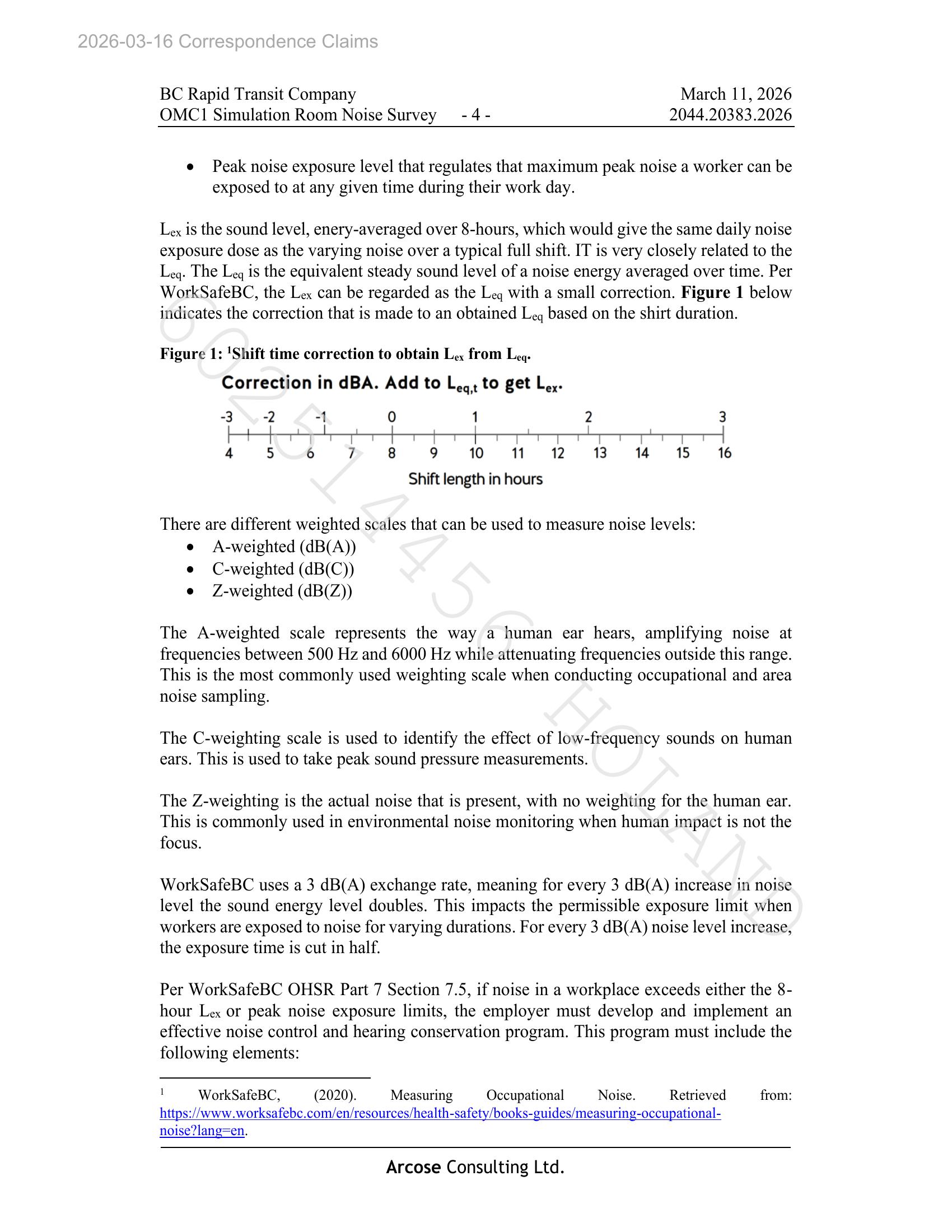
Lex is the sound level, enery-averaged over 8-hours, which would give the same daily noise
exposure dose as the varying noise over a typical full shift. IT is very closely related to the
Leg. The Leg is the equivalent steady sound level of a noise energy averaged over time. Per
WorkSafeBC, the Lex can be regarded as the Leq with a small correction. Figure 1 below
indicates the correction that is made to an obtained Leg based on the shirt duration.

Figure 1: 'Shift time correction to obtain L,x from Leg.
Correction in dBA. Add to L,,; to get L.,.

2 -1 ie) 1 2 3
|
T

a oh 4

|

T

5 6 7 8 9 10 11 12 13 14 15 16
Shift length in hours

There are different weighted scales that can be used to measure noise levels:
e A-weighted (dB(A))
e C-weighted (dB(C))
e Z-weighted (dB(Z))

The A-weighted scale represents the way a human ear hears, amplifying noise at
frequencies between 500 Hz and 6000 Hz while attenuating frequencies outside this range.
This is the most commonly used weighting scale when conducting occupational and area
noise sampling.

The C-weighting scale is used to identify the effect of low-frequency sounds on human
ears. This is used to take peak sound pressure measurements.

The Z-weighting is the actual noise that is present, with no weighting for the human ear.
This is commonly used in environmental noise monitoring when human impact is not the
focus.

WorkSafeBC uses a 3 dB(A) exchange rate, meaning for every 3 dB(A) increase in noise
level the sound energy level doubles. This impacts the permissible exposure limit when
workers are exposed to noise for varying durations. For every 3 dB(A) noise level increase,
the exposure time is cut in half.

Per WorkSafeBC OHSR Part 7 Section 7.5, if noise in a workplace exceeds either the 8-
hour Lex or peak noise exposure limits, the employer must develop and implement an
effective noise control and hearing conservation program. This program must include the
following elements:

! WorkSafeBC, (2020). Measuring Occupational Noise. Retrieved from:
https://www.worksafebc.com/en/resources/health-safety/books-guides/measuring-occupational-
noise?lang=en.

Arcose Consulting Ltd.