🔗 Linked Evidence
CLAIM DENIAL MARCH 23 03
📄 HOLAND_CLAIM_FILE | p.18
📄 HOLAND_CLAIM_FILE | p.18
📝 Extracted Text (OCR)
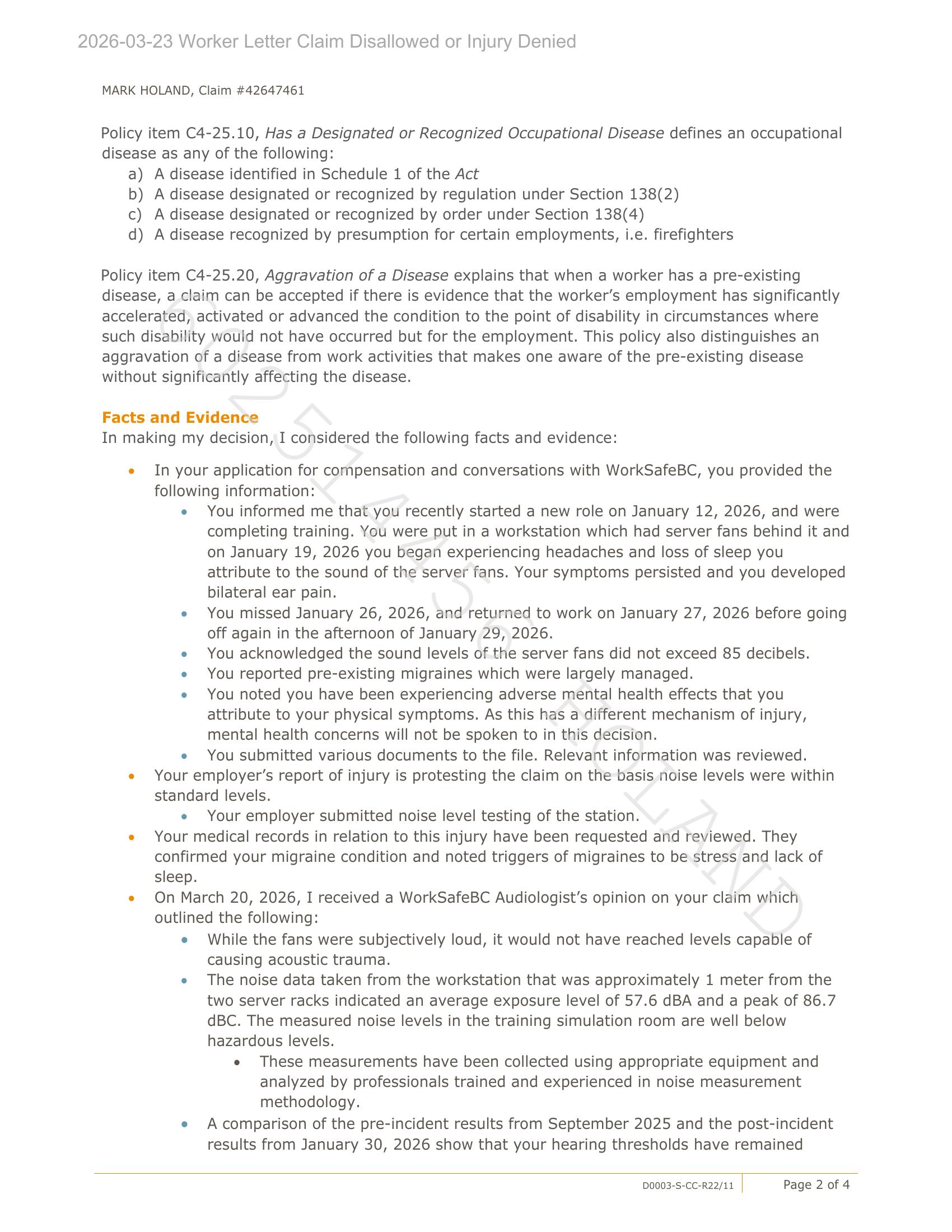
2026-03-23 Worker Letter Claim Disallowed or Injury Denied
MARK HOLAND, Claim #42647461

Policy item C4-25.10, Has a Designated or Recognized Occupational Disease defines an occupational
disease as any of the following:

a) A disease identified in Schedule 1 of the Act

b) A disease designated or recognized by regulation under Section 138(2)

c) A disease designated or recognized by order under Section 138(4)

d) A disease recognized by presumption for certain employments, i.e. firefighters

Policy item C4-25.20, Aggravation of a Disease explains that when a worker has a pre-existing
disease, a claim can be accepted if there is evidence that the worker’s employment has significantly
accelerated, activated or advanced the condition to the point of disability in circumstances where
such disability would not have occurred but for the employment. This policy also distinguishes an
aggravation of a disease from work activities that makes one aware of the pre-existing disease
without significantly affecting the disease.

Facts and Evidence
In making my decision, I considered the following facts and evidence:

e In your application for compensation and conversations with WorkSafeBC, you provided the
following information:

e You informed me that you recently started a new role on January 12, 2026, and were
completing training. You were put in a workstation which had server fans behind it and
on January 19, 2026 you began experiencing headaches and loss of sleep you
attribute to the sound of the server fans. Your symptoms persisted and you developed
bilateral ear pain.

e You missed January 26, 2026, and returned to work on January 27, 2026 before going
off again in the afternoon of January 29, 2026.

e You acknowledged the sound levels of the server fans did not exceed 85 decibels.

e You reported pre-existing migraines which were largely managed.

e You noted you have been experiencing adverse mental health effects that you
attribute to your physical symptoms. As this has a different mechanism of injury,
mental health concerns will not be spoken to in this decision.

e You submitted various documents to the file. Relevant information was reviewed.

e Your employer’s report of injury is protesting the claim on the basis noise levels were within
standard levels.

e Your employer submitted noise level testing of the station.

e Your medical records in relation to this injury have been requested and reviewed. They
confirmed your migraine condition and noted triggers of migraines to be stress and lack of
sleep.

e On March 20, 2026, I received a WorkSafeBC Audiologist’s opinion on your claim which
outlined the following:

e While the fans were subjectively loud, it would not have reached levels capable of
causing acoustic trauma.

e The noise data taken from the workstation that was approximately 1 meter from the
two server racks indicated an average exposure level of 57.6 dBA and a peak of 86.7
dBC. The measured noise levels in the training simulation room are well below
hazardous levels.

e These measurements have been collected using appropriate equipment and
analyzed by professionals trained and experienced in noise measurement
methodology.

e Acomparison of the pre-incident results from September 2025 and the post-incident
results from January 30, 2026 show that your hearing thresholds have remained

DO003-S-CC-R22/11 Page 2 of 4