Tranlink_FOI_Oct_2026 — p.252
📄 Tranlink FOI Oct 2026 | p.252
📄 Tranlink FOI Oct 2026 | p.252
📝 Extracted Text (OCR)
29th June 2026

Dr. Navjot Chaudhary
License Number: 47874

Surrey iScope Concussion & Pain
Clinics
9839 137A St Unit 301

aE tk mnt

Wavefront Centre for
580-2184 West Broadway
Vancouver BC V6K 2E1
(778) 329-0870

WAVEFRONT CENTRE FOR
COMMUNICATION ACCESSIBIUTY

a |
lew Westminster BC VaL0J3
Wok ~— Date of Service 9 Day / stern Year

Astera, #2,

31/03/2025

: ee eeetutzes || ACOUSTIC REFLEX / DECAY

Abs. Absent Present

WRC: Wenn extras Limits WR: Word Rocagnélon Cont. {Cont L IPSIL

EFL Earphones ‘SF: Saundiokd 500Hz| did not .

Otoscopy: clear bitat, NAD. oor, |

QSiN: Rear: 2.dB SNR boss at 70 dB; [2000 Hz| re ee ee

Lear 2 dB SNR loss at 70 dB. { aco
(ed CE oe oe 7

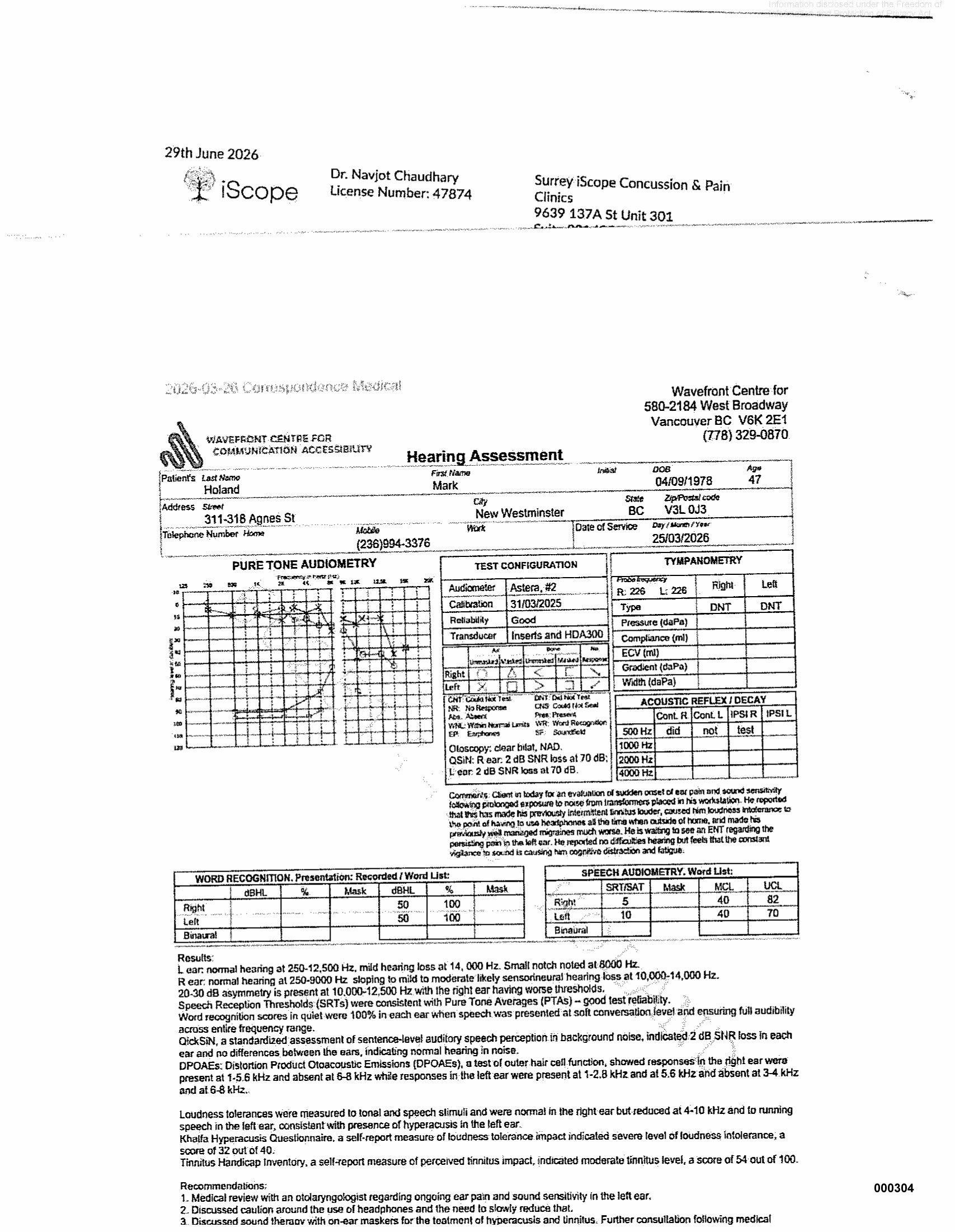
Commas: Ciient in today for an evafuntion of sudden onset of ear pain and sound sensitiity
fofloatng prolonged exposure to nowe from transformers placed in his workstation. He reported
that thes has made his previously intermittent Gnnitus louder, caused him loudness intolerance t
tho pont of having fo usa Headphones all the ma when outside of home, and made tes
pemdously wel managed migraines much worse. Hais waitng to see an ENT regarding the
persisting pon ip the Jeft sar. He reported no dificuties hearing but feels that the constant
‘glance to sound is causing hin cognitive distraction and fatigue.

WORD RECOGNITION. Presentation: Recorded / Word List: SPEECH AUDIOMETRY. Word List:
[aor | % =s {Masi “7 [SRUSAT [Mask _
Right | 50 |
fet | a ee ee
Binaural | { Binabral

Results:

1 ear: normal hearing at 250-12,500 Hz, mild hearing loss at 14, 000 Hz. Small notch noted at:8000 Hz.

Rear: normal hearing al 250-9000 Hz sloping to mild to moderate likely sensorineural hearing loss at 10,000-14,000 Hz.

20-30 dB asymmetry is present at 10,000-12,500 Hz with the right ear having worse thresholds. y

Speech Reception Thresholds: (SRTs) were consistent with Pure Tone Averages (PTAS) - good test reliability.

Word recognition scores in quiet were 100% in each ear when speech was presented at soft conversation Jevel and ensuring full audibility
across entire frequency range. :

OickSiN, a standardized assessment of sentence-lavel auditory speech perception in background noise, indicated:2 dB SNR loss in each
ear and ne differences between the ears, indicating normal hearing in noise. E

DPOAEs: Distortion Product Otoacoustic Emissions (DPOAEs), a test of outer halr cell function, showed responses: in the fight ear were
Present rH 4-5.6 kHz and absent at 6-8 kHz whie responses in: the left ear were present at 1-2.8 kHz and at §.6 kHz and absent at 3-4 kHz
and at 6-8 kHz.

Loudness tolerances were measured to tonal and speech slimuli and were norma! in the right ear but seduced at 4-10 kHz and to running
speech in the feft ear, consistent with presence of hyperacusis in the teft ear.

Khalfa Hyperacusis Questionnaire, a self-report measure of loudness tolerance. impact indicated severe level of loudness intolerance, a
score of 32 out of 40:

Tinnitus Handicap Inventory, a self-eport measure of perceived tinnitus impact, indicated moderate tinnitus evel, a score of 54 out of 100.

Recommendations;

1. Medical review with an otolaryngologist regarding ongoing ear pain and sound sensitivity in the left ear,

2. Discussed caulion around the use of headphones and the need to slowly reduce that.

2. Discussed sound theraav vith on-ear maskers for the teatment of hyperacusis and Unnitus. Further consultation following medical

000304