← Back
📁 MARK'S DOC
🔗 Linked Evidence
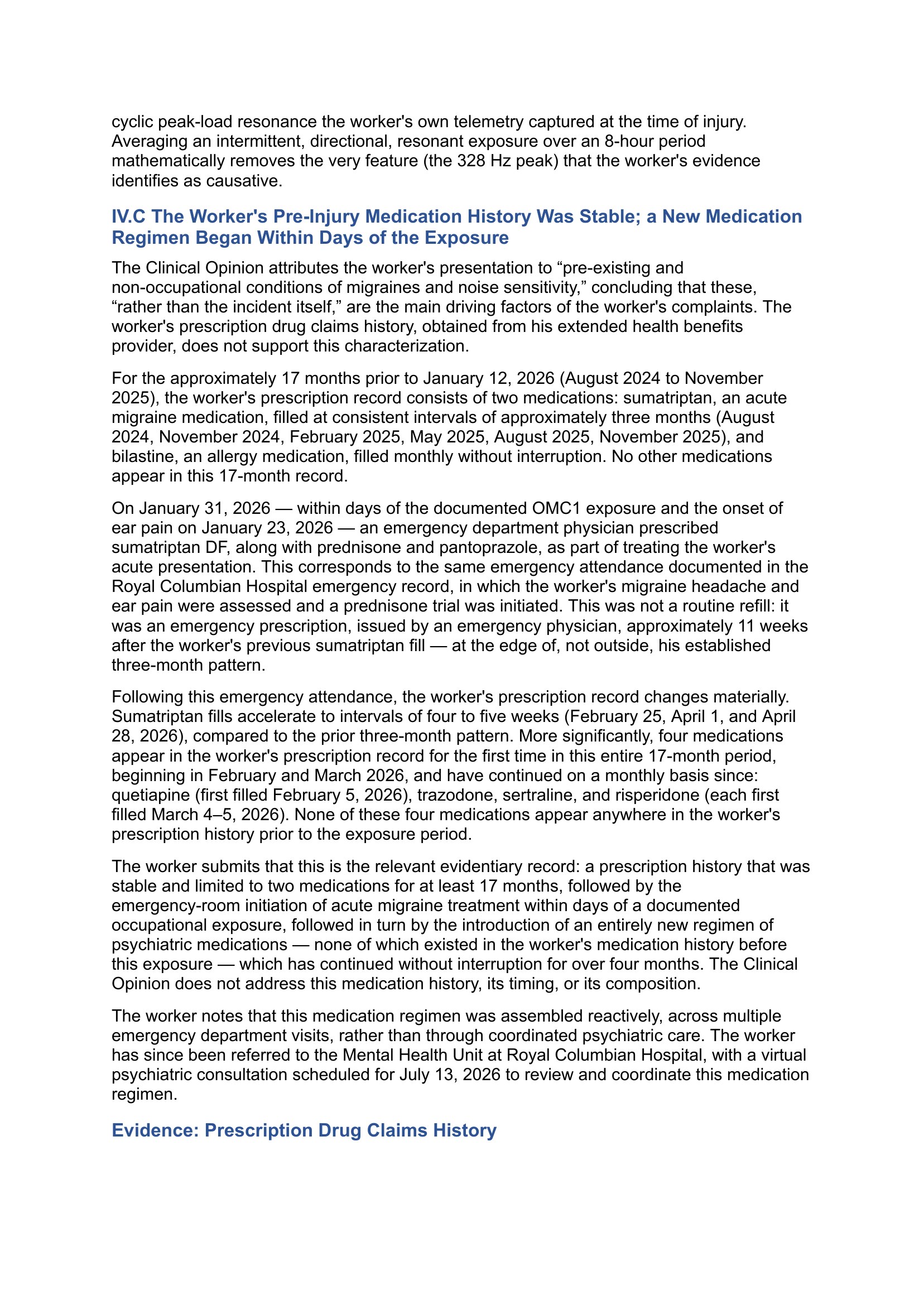
Review_Division_Submission_3_of_3 — p.10
📄 Review Division Submission 3 of 3 | p.10
📄 Review Division Submission 3 of 3 | p.10
📝 Extracted Text (OCR)
cyclic peak-load resonance the worker's own telemetry captured at the time of injury.
Averaging an intermittent, directional, resonant exposure over an 8-hour period
mathematically removes the very feature (the 328 Hz peak) that the worker's evidence
identifies as causative.

IV.C The Worker's Pre-Injury Medication History Was Stable; a New Medication
Regimen Began Within Days of the Exposure

The Clinical Opinion attributes the worker's presentation to “pre-existing and
non-occupational conditions of migraines and noise sensitivity,” concluding that these,
“rather than the incident itself,” are the main driving factors of the worker's complaints. The
worker's prescription drug claims history, obtained from his extended health benefits
provider, does not support this characterization.

For the approximately 17 months prior to January 12, 2026 (August 2024 to November
2025), the worker's prescription record consists of two medications: sumatriptan, an acute
migraine medication, filled at consistent intervals of approximately three months (August
2024, November 2024, February 2025, May 2025, August 2025, November 2025), and
bilastine, an allergy medication, filled monthly without interruption. No other medications
appear in this 17-month record.

On January 31, 2026 — within days of the documented OMC1 exposure and the onset of
ear pain on January 23, 2026 — an emergency department physician prescribed
sumatriptan DF, along with prednisone and pantoprazole, as part of treating the worker's
acute presentation. This corresponds to the same emergency attendance documented in the
Royal Columbian Hospital emergency record, in which the worker's migraine headache and
ear pain were assessed and a prednisone trial was initiated. This was not a routine refill: it
was an emergency prescription, issued by an emergency physician, approximately 11 weeks
after the worker's previous sumatriptan fill — at the edge of, not outside, his established
three-month pattern.

Following this emergency attendance, the worker's prescription record changes materially.
Sumatriptan fills accelerate to intervals of four to five weeks (February 25, April 1, and April
28, 2026), compared to the prior three-month pattern. More significantly, four medications
appear in the worker's prescription record for the first time in this entire 17-month period,
beginning in February and March 2026, and have continued on a monthly basis since:
quetiapine (first filled February 5, 2026), trazodone, sertraline, and risperidone (each first
filled March 4—5, 2026). None of these four medications appear anywhere in the worker's
prescription history prior to the exposure period.

The worker submits that this is the relevant evidentiary record: a prescription history that was
stable and limited to two medications for at least 17 months, followed by the
emergency-room initiation of acute migraine treatment within days of a documented
occupational exposure, followed in turn by the introduction of an entirely new regimen of
psychiatric medications — none of which existed in the worker's medication history before
this exposure — which has continued without interruption for over four months. The Clinical
Opinion does not address this medication history, its timing, or its composition.

The worker notes that this medication regimen was assembled reactively, across multiple
emergency department visits, rather than through coordinated psychiatric care. The worker
has since been referred to the Mental Health Unit at Royal Columbian Hospital, with a virtual
psychiatric consultation scheduled for July 13, 2026 to review and coordinate this medication
regimen.

Evidence: Prescription Drug Claims History