← Back
📁 MARK'S DOC
🔗 Linked Evidence
Review_Division_Submission_3_of_3 — p.9
📄 Review Division Submission 3 of 3 | p.9
📄 Review Division Submission 3 of 3 | p.9
📝 Extracted Text (OCR)
Wavefront Centre for

580-2184 West Broadway

Vancouver BC V6K 2E1

WAVEFRONT CENTRE FOR (778) 329-0870

COMMUNICATION ACCESSIBILITY .
Hearing Assessment

Patient's Last Name First Name Initial DOB ‘Age
Holand Mark 04/09/1978 47
‘Address Street City State Zip/Postal code
311-318 Agnes St New Westminster BC V3L0J3
‘Telephone Number Home Mobile Work Date of Service — Day/Month/ Year
(236)994-3376 25/03/2026
PURE TONE AUDIOMETRY. TEST CONFIGURATION TYMPANOMETRY
requeney in hertz (2)
ws ewe tom task tm eee
, LILILCL OL aeons Astera, #2 R226 1: 226 | Right Left
A libration | 31/03/2025
i i eer Type DNT DNT
al t ‘liability | Good Pressure (daPa)
qe
ae Transducer _| Inserts and HDA300 Compliance (ml)
3 i Tone No
in mast Wasted Unmasked] Masked Response] |_ ECV (ml)
ig Rent] © TAT < | LIN || Gradient (daPa)
g tet | x [OIL > [oI] — || Width daPay
a nul ic
* Me Nears CNEL Gudi Not baal ACOUSTIC REFLEX / DECAY
‘ps: Absent Pres: Pre
= COO tiie ent gic Cont.R [cont [IPSi R [PSI
= EP: Earphones SF: Soundfield s00Hz| did | not | test
Otoscopy: clear bilat, NAD. 1000 Hz|
QSIN: R ear: 2 dB SNR loss at 70 dB; | [2000 Hz
Lear: 2 dB SNR loss at 70 dB. 4000 Hz!
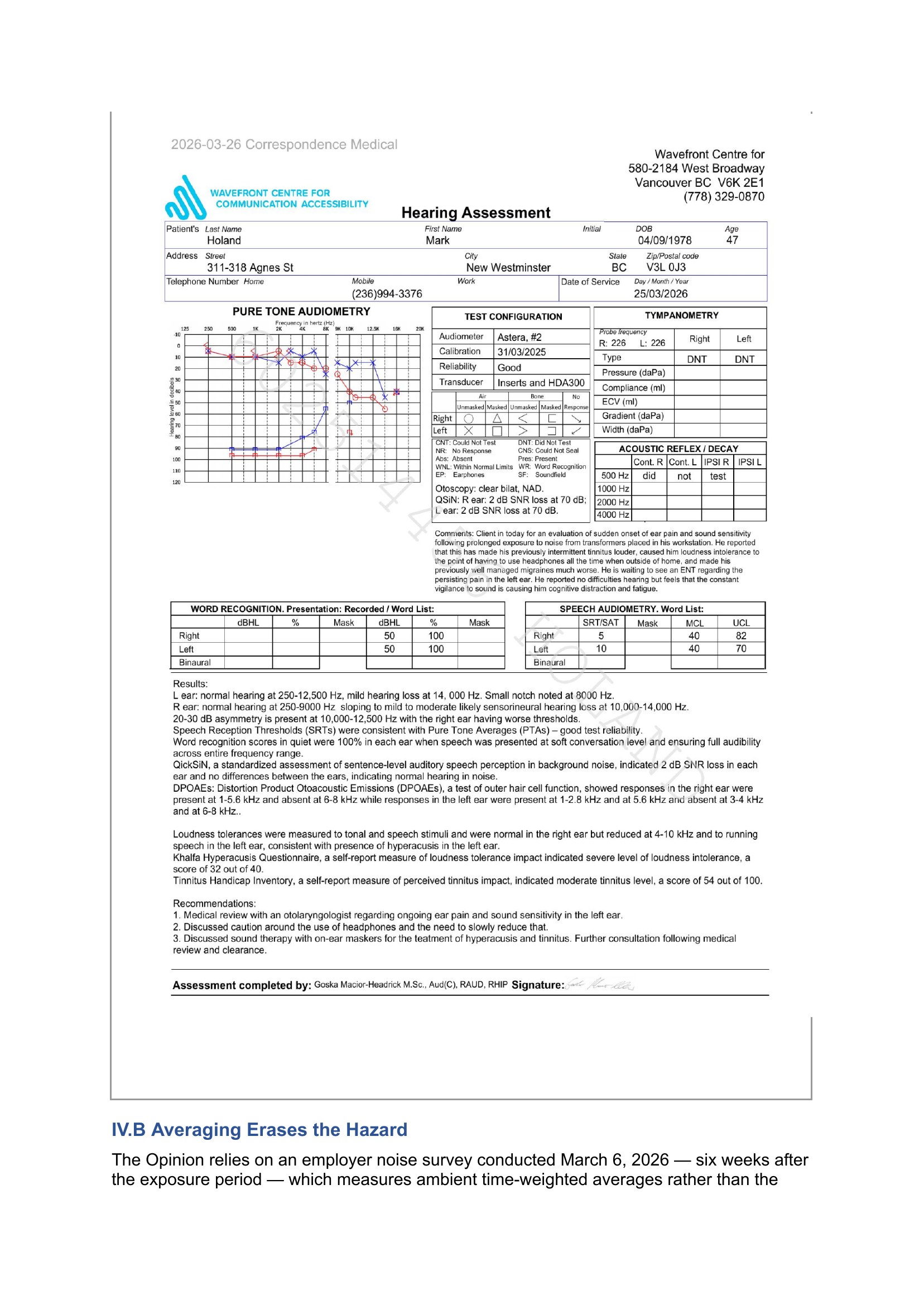
Comments: Client in today for an evaluation of sudden onset of ear pain and sound sensitivity
following prolonged exposure to noise from transformers placed in his workstation. He reported
that this has made his previously intermittent tinnitus louder, caused him loudness intolerance to
the point of having to use headphones all the time when outside of home, and made his
previously well managed migraines much worse. He is waiting to see an ENT regarding the
persisting pain in the left ear. He reported no difficulties hearing but feels that the constant
vigilance to sound is causing him cognitive distraction and fatigue.
WORD RECOGNITION. Presentation: Recorded / Word List: SPEECH AUDIOMETRY. Word List:
dBHL % Mask | dBHL % Mask [_ SRT/SAT | Mask MCL UCL
Right 50 100 Right 5 40 82
Left 50 100 Left 10 40 70
Binaural Binaural
Results:

L ear: normal hearing at 250-12,500 Hz, mild hearing loss at 14, 000 Hz. Small notch noted at 8000 Hz.

R ear: normal hearing at 250-9000 Hz sloping to mild to moderate likely sensorineural hearing loss at 10,000-14,000 Hz.

20-30 dB asymmetry is present at 10,000-12,500 Hz with the right ear having worse thresholds.

Speech Reception Thresholds (SRTs) were consistent with Pure Tone Averages (PTAs) — good test reliability.

Word recognition scores in quiet were 100% in each ear when speech was presented at soft conversation level and ensuring full audibility
across entire frequency range.

QickSiN, a standardized assessment of sentence-level auditory speech perception in background noise, indicated 2 dB SNR loss in each
ear and no differences between the ears, indicating normal hearing in noise.

DPOAEs: Distortion Product Otoacoustic Emissions (DPOAEs), a test of outer hair cell function, showed responses in the right ear were
present at 1-5.6 kHz and absent at 6-8 kHz while responses in the left ear were present at 1-2.8 kHz and at 5.6 kHz and absent at 3-4 kHz
and at 6-8 kHz...

Loudness tolerances were measured to tonal and speech stimuli and were normal in the right ear but reduced at 4-10 kHz and to running
speech in the left ear, consistent with presence of hyperacusis in the left ear.

Khalfa Hyperacusis Questionnaire, a self-report measure of loudness tolerance impact indicated severe level of loudness intolerance, a
score of 32 out of 40.

Tinnitus Handicap Inventory, a self-report measure of perceived tinnitus impact, indicated moderate tinnitus level, a score of 54 out of 100.

Recommendations:

1. Medical review with an otolaryngologist regarding ongoing ear pain and sound sensitivity in the left ear.

2. Discussed caution around the use of headphones and the need to slowly reduce that.

3. Discussed sound therapy with on-ear maskers for the teatment of hyperacusis and tinnitus. Further consultation following medical
review and clearance.

Assessment completed by: Goska Macior-Headrick M.Sc., Aud(C), RAUD, RHIP Signature:

IV.B Averaging Erases the Hazard

The Opinion relies on an employer noise survey conducted March 6, 2026 — six weeks after
the exposure period — which measures ambient time-weighted averages rather than the